On AI
I don't enjoy having to repeat the same evidence every time, so I decided to put all of my answers here. If you don't care enough to read it, fine by me, but criticizing me while refusing to engage with the evidence is performative.
On the other hand, if you decide to read it, thank you for at least taking the time to do so, even if it's just out of hatred. My answers are backed by studies or evidence when possible, so if you decide to argue against them, the very least I expect is for you to be able to do the same (with a credible source, of course).
If you don't, I'm afraid I will probably just ignore you. If you do, and you actually present an argument that makes me change my mind, congratulations! We've had a productive conversation, something not as common nowadays, and our beliefs are probably not as far apart as you might initially think. Furthermore, I will present your argument and praise it somewhere on this page.
I love having productive discussions with people who challenge my beliefs. Sadly, this is not normally the case: a lot of the criticism I get comes from "hate mobs" that rarely present good arguments or understand the topic they choose to hate. If your knowledge of AI consists purely of TikTok and/or echo-chamber content, it is most likely contradicted by the answers below.
My replies will inevitably have some personal opinion behind them, but I will try to keep them as objective as possible. If you want to attack my philosophy, cool, but data is data, and neither your opinion nor mine changes it.
My stance
For obvious reasons, I will only defend what I use and agree with, so I would like to specify my stance:
I don't support or encourage the use of AI as an end product in creative fields (illustration, writing, music).
I don't support or encourage the use of AI for the production of false real-life media (images, video).
I support the use of AI in software engineering (coding).
Why? Isn't this a double standard? Simply because I don't consider typing the code itself to be the creative part of software engineering. For me, the creative work lies in the idea, product direction, architecture, and decisions. Code is just a means to that end. This is completely subjective, and I know some people disagree, which I respect. AI can help write the code without replacing my thought process, creative direction, review, testing, or responsibility for the result. You can argue that AI is good or bad at writing code, but that's a different discussion.
Generative AI is built on stolen work Using generative AI means benefiting from work stolen from artists
The blanket claim that training data is "stolen work" collapses several different questions: whether a source was lawfully obtained, whether training on it is permitted under the applicable copyright law, and whether a model reproduces protected expression. It assumes that using a work to learn statistical patterns is equivalent to copying and redistributing the work as-is, when it isn't.2
Under U.S. copyright law, copyright protects a codebase's original expression, not the ideas, processes, systems, methods, concepts, or principles behind it.1 In Bartz v. Anthropic, the court held that the training use at issue was fair use while separately rejecting fair-use protection for Anthropic's permanent library of pirated books.2
A lot of the people I see using this argument are artists. Being an artist does not, by itself, make someone an authority on how software tools are built. Art and code are both copyrightable expression,1 but the two contexts are not interchangeable. Generated code still sits inside a system that has to be designed, integrated, reviewed, tested, maintained, and licensed. If you want to criticize my use of AI in software engineering, criticize that actual workflow instead of importing assumptions from image generation.
Sources
- U.S. Congress, "17 U.S.C. Section 102: Subject Matter of Copyright: In General" (1976). ←
- U.S. District Court for the Northern District of California, "Bartz v. Anthropic: Order on Fair Use" (2025). ←
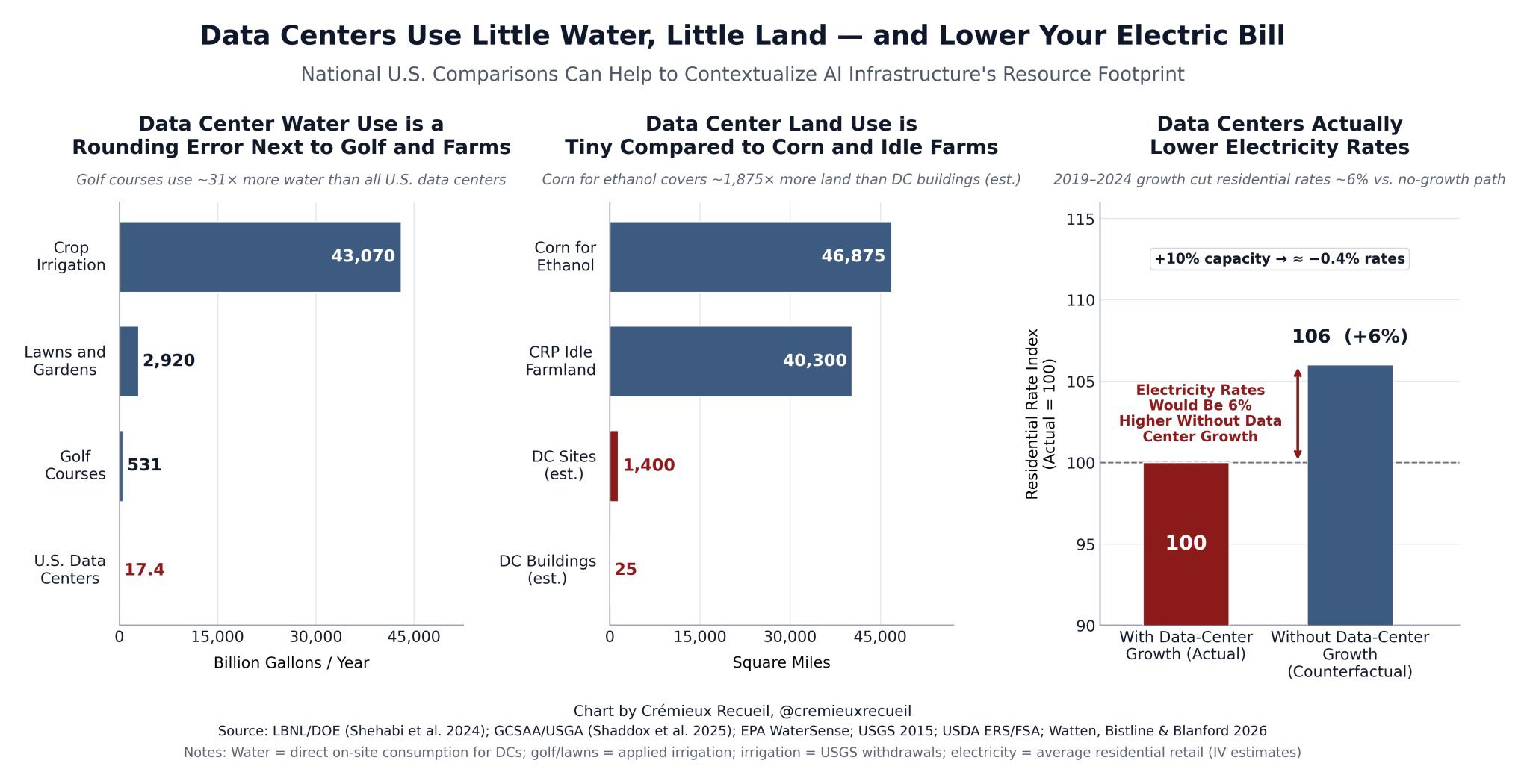
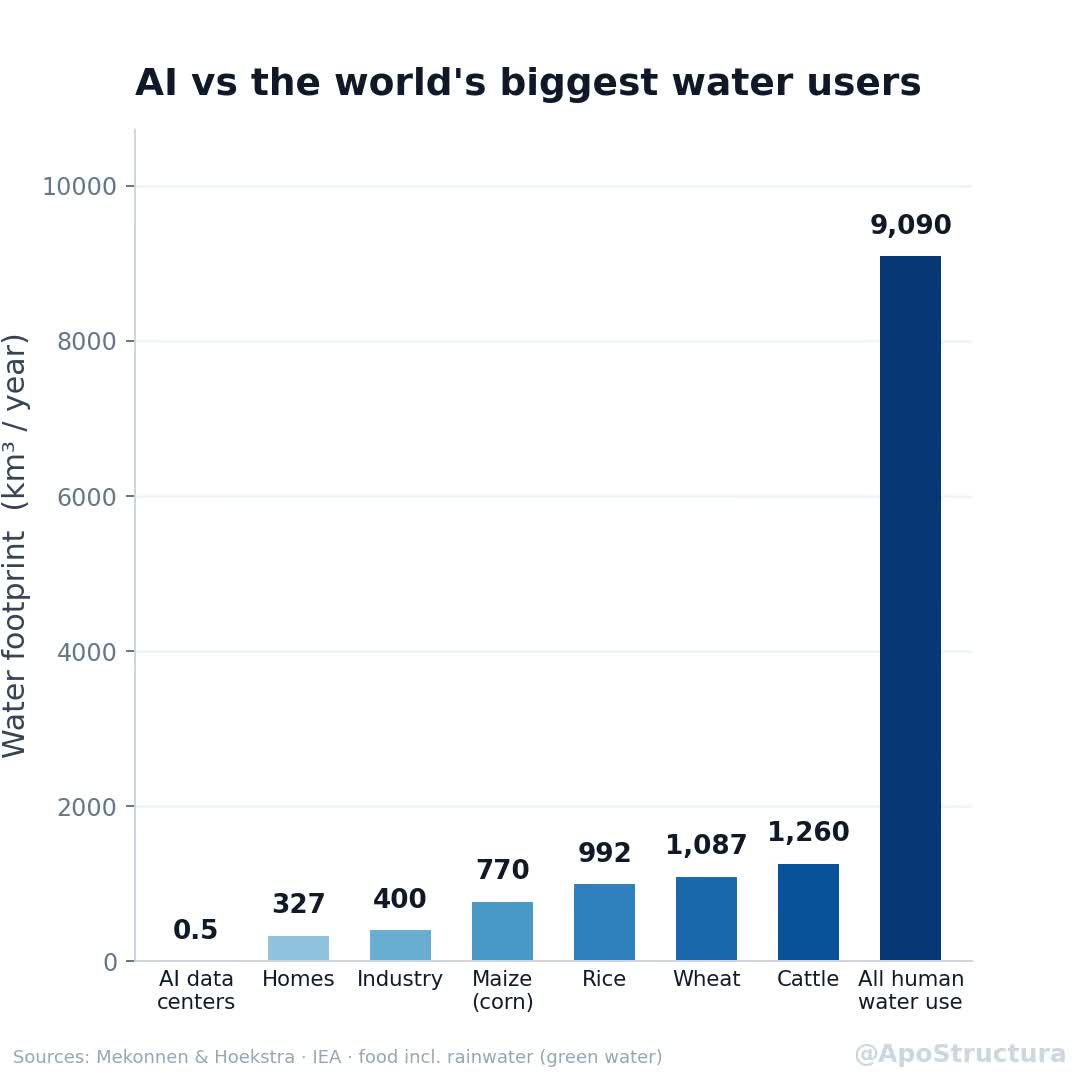
AI and data centers consume enormous amounts of water and pollute local water supplies Data centers are ruining local communities by eating a ton of water and doubling energy prices
The AI and data-center water argument is genuinely a psyop by the oil and gas industry to distract from the fact that they are the most problematic producers of energy.[3, 4] One of the first widely circulated mainstream articles about it was published by The Washington Post.5
There is a ton of misinformation in that article. For instance, the main data point presented is literally made up! It cites a UC Riverside paper that models GPT-3 and estimates about 16.9 ml per medium request, while explicitly stating that GPT-4's resource use was not publicly known.6 The Post supplied a separate, undisclosed GPT-4 estimate of 519 ml and 140 Wh per 100-word email, approximately 35 times and 31 times higher than the cited paper's actual energy and water estimates.5 Later production measurements found approximately 0.24 Wh and 0.26 ml per median text prompt, making the initial data roughly 583x and 1,996x higher than the real measurements.7 The base of the argument is built on misinformation, just like everything that came afterward.
This blog goes much more in-depth into it than I will in this answer. If you're genuinely interested in the "water problem," go read it.
Andy Masley's analysis separates direct data-center cooling from indirect water used by power plants, arguing that much of the reported AI water footprint comes from electricity generation, not the data centers themselves. The Lawrence Berkeley National Laboratory makes the same distinction and estimates that, across all U.S. data centers in 2023, indirect water consumption was nearly 800 billion liters versus 66 billion liters of direct consumption.8 Masley argues that data centers are not a notable source of water-quality pollution; an EPA case study documents cooling-water treatment, recycling, and closed-loop reuse at a Microsoft facility.9
Meanwhile, the EPA identifies agricultural runoff as the leading cause of water-quality impacts to U.S. rivers and streams,10 while construction runoff is recognized as a significant source of sediment and other pollutants.11
Sources
- Intergovernmental Panel on Climate Change, "Climate Change 2022: Mitigation of Climate Change, Chapter 6: Energy Systems" (2022). ←
- World Health Organization, "Air Pollution" (n.d.). ←
- The Washington Post, "A Bottle of Water per Email: The Hidden Environmental Costs of Using AI Chatbots" (2024). ←
- Pengfei Li et al., "Making AI Less 'Thirsty': Uncovering and Addressing the Secret Water Footprint of AI Models" (2023). ←
- Google, "Measuring the Environmental Impact of Delivering AI at Google Scale" (2025). ←
- Lawrence Berkeley National Laboratory, "2024 United States Data Center Energy Usage Report" (2024). ←
- U.S. Environmental Protection Agency, "Water Reuse Case Study: Quincy, Washington" (2023). ←
- U.S. Environmental Protection Agency, "Nonpoint Source: Agriculture" (2015). ←
- U.S. Environmental Protection Agency, "Stormwater Discharges from Construction Activities" (2015). ←
- Lawrence Berkeley National Laboratory, "2024 United States Data Center Energy Usage Report" (data-center water). ←
- Shaddox et al., "Survey of Water Use and Management Practices on U.S. Golf Courses from 2005 to 2024" (golf-course water). ←
- EPA WaterSense, "Outdoors" (residential outdoor water). ←
- USGS, "Water Use in the United States: 2015 Data" (crop-irrigation withdrawals). ←
- USDA ERS, "Corn-based ethanol production in the United States" (corn used for ethanol). ←
- USDA FSA, "Conservation Reserve Program Statistics" (CRP land). ←
- Watten, Bistline, and Blanford, "Have Data Centers Raised Your Electric Bill?" (modeled electricity-rate effect). ←
- International Energy Agency, "Energy and AI" (global data-center water consumption). ←
- Hoekstra and Mekonnen, "The Water Footprint of Humanity" (global, industrial, and domestic totals). ←
- Mekonnen and Hoekstra, "The Green, Blue and Grey Water Footprint of Crops and Derived Crop Products" (wheat, rice, and maize). ←
- Mekonnen and Hoekstra, "A Global Assessment of the Water Footprint of Farm Animal Products" (beef and dairy cattle). ←
AI is stealing people's jobs
If you have been "replaced" by AI, it means your employer believed doing so was advantageous; whether because you were mediocre or bad at your job, or because replacing you would maximize profit. If your company accepted worse work from AI, then you were the casualty of a profit-maximizing business decision enabled by capitalism, not AI.[23, 24, 25, 26]
Norwegian private-sector payroll-register data through February 2026 showed employment growth of 0.1% in the most AI-exposed occupations versus 0.3% in the least exposed. A separate U.S.-Europe study found no clear evidence that industry-level AI adoption was associated with employment changes.[27, 28, 29]
Sources
- Wikipedia, "Global Labor Arbitrage" (n.d.). ←
- Wikipedia, "Offshoring" (n.d.). ←
- David H. Autor, "The 'Task Approach' to Labor Markets: An Overview" (2013). ←
- OECD, "Offshoring, Reshoring, and the Evolving Geography of Jobs" (2024). ←
- IZA Institute of Labor Economics, "Large Language Models, Small Labor Market Effects" (2026). ←
- National Bureau of Economic Research, "AI Adoption and the Demand for Labor" (2026). ←
- Federal Reserve Bank of St. Louis, "Mind the Gap: AI Adoption in Europe and the U.S." (2026). ←
Claude/ChatGPT/Gemini did everything, you have no merit This was vibecoded, so it must be bad Why don't you learn how to code instead of delegating it to an AI? Are you dumb?
"Vibecoding" has commonly been used by non-technical people as a buzzword. It has lost its original meaning, just like most area-specific words that end up going mainstream. You might see this buzzword used to negatively describe any project that has used any sort of AI.
In reality, the term originated with AI researcher Andrew Karpathy in February 2025, when he described it as a form of coding where you "fully give in to the vibes, embrace exponentials, and forget that the code even exists,"30 aka accepting AI-generated code or decisions without reviewing the output. A key part of the definition is a lack of knowledge about the code and the decisions made. If an LLM wrote every line of your code, but you've reviewed, tested, and understood it all, that's not vibecoding.
With that out of the way, most non-technical people assume that AI assistance or use in software engineering consists of "vibecoding." That is not the case for most software, nor for my projects: I make, review, and test every single decision. I don't delegate my thought process and creativity to AI. I put countless hours of effort into my projects. You're directly disrespecting my work.
Either way, if you still think building these projects is easy,[31, 32] I encourage you to take my job, or any job in tech (SWE, AI/ML, etc.). It's one of the highest-paying fields,33 so it should be a no-brainer ;)
Sources
- Andrej Karpathy, original description of "vibe coding" (2025). ←
- Wikipedia, "Egg of Columbus" (n.d.). ←
- Wikipedia, "Hindsight Bias" (n.d.). ←
- U.S. Bureau of Labor Statistics, "Computer and Information Technology Occupations" (2025). ←
Why are you hiding your AI usage?
I don't hide my AI usage, you're just blind lol. In fact, I'm pretty explicitly open about it (as this page itself demonstrates). If you look through my GitHub, you will see AI-related projects. If you look through my X/Twitter profile, my biography has "AI" in it, and a quick scroll through my timeline will show discourse and replies around it. If you look through my website, you will find an "AI" dropdown with a few pages, including this one. I would say it's hard to be much more open than this when a good chunk of my internet presence nowadays revolves around it.
You might see someone asking me if AI was used on one of my projects and notice me purposefully ignoring them. These people have not done a single bit of research on me (or they would've obtained their answer otherwise) and just want a reason to attack the project, whether by themselves or alongside a hate mob. 99% of the time, they're ignorant people who, as I said above, have learned about AI only through echo chambers and have no idea how it works, so I won't play their game.
In fact, I'll make it even easier for the few willing to do research: yes, I have most likely used AI in the development of whatever you're asking about.
Some examples of projects that have been attacked purely because critics saw the word "AI" in them, with no solid argument to back up the criticisms whatsoever:
Using AI makes you a fascist, a conservative, or a class traitor
A lot of my takes on AI are shaped by my political and personal beliefs, but I can't be bothered to go in depth. I don't like to lock all my ideas into a "tag," but I would consider myself a leftist (pretty extreme, too). Trans rights, fuck capitalism, yada yada yada. If you think being a leftist is incompatible with being pro-AI (I guess because most people assume AI = right wing), you should probably work on forming your own opinion instead of regurgitating talking points from others.I won't use your tool because AI was used to build it I refuse to use anything AI contributed to
Cool! I hope you don't use Windows,[34, 35, 36] Linux,[37, 38, 39] macOS,40 iOS,40 Android,[41, 42, 43] YouTube,[44, 45, 46] X/Twitter,[47, 48] Instagram,[49, 50] Reddit,[51, 52] Facebook,49 TikTok,53 Spotify,[54, 55] Netflix,[56, 57] Snapchat,[58, 59] Discord,[60, 61] search engines,[62, 63] online shopping,64 recommendation feeds,[44, 53] spam filters,[65, 66] predictive text,[67, 68] translation apps,[69, 70] navigation,[71, 72, 73] ride-hailing,[74, 75] phone cameras,[76, 77, 78] online banking,[79, 80, 81] weather forecasts,[82, 83] or any internet-connected or smart device.[84, 85] If you do, you're already accepting AI-mediated technology when it is convenient and relying on ecosystems that include, integrate, and encourage AI; thus, you're a hypocrite.
But those are not generative AI, they dont count
Many of them contain commits with AI-generated code. The Linux kernel documents AI-assisted contributions and includes examples of patches and scripts made with LLMs, even if Linux in itself is not a chatbot.[86, 87, 88]
And this is not limited to Linux. Android's official kernel source contains commits with AI-generated code.89 Microsoft documents AI-generated contributions to the .NET/runtime project.90 Google documents using generative AI in its internal code-migration work.91 Meta documents CodeCompose, an AI-assisted code-authoring tool used by its developers.92 Contributors to FFmpeg (the open-source multimedia framework for decoding, encoding, and processing audio and video; an essential piece of infrastructure behind video playback, conversion, streaming, and countless apps online) actively use AI coding tools in development and code review.[93, 94] And just like these, hundreds of others examples.
Ordinary software does not need to be a generative-AI product (ex. ChatGPT, Claude, Gemini, etc) to contain code, tests, documentation, or fixes generated by AI. Some of the listed services involve direct generative-AI use too: Google Search has AI Overviews,62 Copilot generates content with generative models,34 Apple Intelligence integrates generative models into iOS and macOS,40 Meta AI operates inside Facebook and Instagram,49 and Snapchat identifies My AI and AI Lenses as generative-AI features.[58, 59] If you have used those features, you have directly used generative AI too.
Sources
- Microsoft, "Your AI Assistant Across Windows & Edge" (n.d.). ←
- Microsoft, "Retrace Your Steps with Recall" (n.d.). ←
- Microsoft, "Advanced Technologies at the Core of Microsoft Defender Antivirus" (n.d.). ←
- Linux Foundation, "Linux Foundation Welcomes the Open Model Initiative to Promote Openly Licensed AI Models" (2024). ←
- Linux kernel source tree, commits matching "Assisted-by" (n.d.). ←
- Linus Torvalds, "Linux is not one of those anti-AI projects" (2026). ←
- Apple, "Introducing Apple Intelligence for iPhone, iPad, and Mac" (2024). ←
- Google, "What You Can Do with Your Gemini Mobile App - Android" (n.d.). ←
- Google, "Introducing Android 9 Pie" (2018) (Adaptive Battery built with DeepMind, ML-driven Adaptive Brightness). ←
- Google, "The Latest AI Features Coming to Android" (2024). ←
- YouTube, "Learn More About How YouTube Works for You" (n.d.). ←
- YouTube, "YouTube's AI Power-Up: How We Got Even More Helpful This Year" (2024). ←
- YouTube, "Our Approach to Responsible AI Innovation" (n.d.). ←
- X, "About Grok, Your Humorous AI Assistant on X" (n.d.). ←
- X/Twitter, "Source Code for the X Recommendation Algorithm" (2023). ←
- Meta, "Meet Your New Assistant: Meta AI, Built With Llama 3" (2024). ←
- Meta, "How AI Powers Experiences on Facebook and Instagram: System Cards" (2024). ←
- Reddit, "Introducing Reddit Answers" (2024). ←
- Reddit, "How We're Keeping Reddit Real and Safe in the AI Era" (2024). ←
- TikTok, "How TikTok Recommends Videos #ForYou" (2020). ←
- Spotify Engineering, "How Spotify Uses ML to Create the Future of Personalization" (2021). ←
- Spotify Newsroom, "Spotify Debuts a New AI DJ, Right in Your Pocket" (2023). ←
- Netflix Technology Blog, "Foundation Model for Personalized Recommendation" (2025). ←
- Netflix Technology Blog, "Artwork Personalization at Netflix" (2017). ←
- Snap Inc., "Snap and Google Cloud Expand Partnership to Power Generative AI Experiences" (2024). ←
- Snap Inc., "Introducing New AI-Powered Tools in Lens Studio" (2024). ←
- Discord, "Our Approach to Content Moderation" (2024). ←
- Discord, "Discord is Your Place for AI with Friends" (2023). ←
- Google, "Generative AI in Search: Let Google Do the Searching for You" (2024). ←
- Google, "Understanding Searches Better Than Ever Before" (2019) (BERT in Search). ←
- Amazon Science, "The History of Amazon's Recommendation Algorithm" (n.d.). ←
- Google, "New Gmail Protections for a Safer, Less Spammy Inbox" (2023). ←
- Microsoft, "Anti-Spam Protection in Microsoft Defender for Office 365" (n.d.). ←
- Apple, "What's New in the Updates for macOS Sonoma 14" (n.d.). ←
- Google Research, "Improving Gboard Language Models via Private Federated Analytics" (n.d.). ←
- Google, "Found in Translation: More Accurate, Fluent Sentences in Google Translate" (2016). ←
- Google, "Google Translate Gets New Gemini AI Translation Models" (2025). ←
- Google, "New Maps Updates: Immersive View for Routes and Other AI Features" (2023). ←
- Google, "Google Maps 101: How AI Helps Predict Traffic and Determine Routes" (2020). ←
- Google DeepMind, "Traffic Prediction with Advanced Graph Neural Networks" (2020). ←
- Uber Engineering, "Engineering More Reliable Transportation with Machine Learning" (2017). ←
- Uber Engineering, "DeepETA: How Uber Predicts Arrival Times Using Deep Learning" (2022). ←
- Google Research, "Night Sight: Seeing in the Dark on Pixel Phones" (2018). ←
- Google Research, "Portrait Mode on the Pixel 2 and Pixel 2 XL Smartphones" (2017). ←
- Apple Machine Learning Research, "On-device Panoptic Segmentation for Camera" (2021). ←
- U.S. Department of the Treasury, "Enhanced Fraud Detection Processes, Including Machine Learning AI, Prevented and Recovered Over $4 Billion" (2024). ←
- Federal Reserve Board, Governor Bowman on AI in Financial Services (2024). ←
- U.S. Government Accountability Office, "Artificial Intelligence: Use and Oversight in Financial Services" (2025). ←
- ECMWF, "AIFS: A New ECMWF Forecasting System" (2024). ←
- Google DeepMind, "GraphCast: Learning Skillful Medium-Range Global Weather Forecasting" (2023). ←
- Stack Overflow, "2025 Developer Survey: AI" (widespread use of AI tools in software development). ←
- Google DeepMind, "How AlphaChip Transformed Computer Chip Design" (documented use of AI in production chip layouts). ←
- LWN, "No disclosure for LLM-generated patch?" (2025). ←
- LWN, "Supporting kernel development with large language models" (2025). ←
- Linux Kernel Documentation, "AI coding assistants". ←
- LKML, "gpio: rockchip: fix ..." (2026). ←
- Microsoft .NET Blog, "Ten Months with Copilot Coding Agent in dotnet/runtime" (2026). ←
- Google Research, "Accelerating code migrations with AI" (2024). ←
- Meta, "CodeCompose: A Large-Scale Industrial Deployment of AI-assisted Code Authoring" (2023). ←
- FFmpeg, thank-you post for Cursor free credits supporting development and code review (2026). ←
- FFmpeg, thank-you post for Claude for Open Source / Claude Max support and missing 9.0 backports (2026). ←
AI is literally destroying books You're defending an industry that burns knowledge AI companies are anonymously buying and destroying millions of books
I hate destroying books as much as the next guy, but you’re pointing your guns at the wrong target (again). Anthropic did physically destroy the books, but one major reason it did so was the copyright regime a lot of you seem to thoughtlessly preach. It destructively scanned legally purchased print copies to create digital replacements, then discarded the originals; the information wasn’t erased permanently, as many people seem to believe. Destroying the originals made the process much easier to defend in court as a one-for-one format shift rather than the creation of additional copies. "The format change itself added no new copies, eased storage and enabled searchability, and was not done for purposes trenching upon the copyright owner's interests" as per Bartz v. Anthropic.[95, 96]
One of the things that triggers me the most is when people hate on a thing I hate in such an absolutely incompetent way that it degrades the quality of the conversation I can have; when people hate on Anthropic for things that don’t matter or that they didn’t do, it pisses me off because I hate Anthropic and I want to tear them down for the actual shit they fuck up.